Choosing between Hybrid Vegetable Seed Suppliers Gujarat is not simply about finding the lowest price per packet. Seed quality can influence crop establishment, uniformity, harvest timing, fruit quality and ultimately the economics of cultivation.
For farmers, dealers, FPOs and institutional buyers, the better approach is to compare suppliers on measurable factors rather than marketing claims. You can explore the range through Hybrid Vegetable Seed Suppliers in Gujarat while using the checks below to assess whether a supplier fits your crop and market requirements.
1. Start With Crop and Regional Suitability
A hybrid that performs well in one location may not give the same result under different soil, temperature, irrigation or disease conditions.
Before selecting a supplier, identify:
- Target crop and growing season
- Local climate and temperature range
- Irrigation availability
- Soil type and fertility
- Major pest and disease pressure
- Intended market and buyer preference
For Gujarat farmers, regional performance information can be especially useful when comparing vegetable seed options.
Ask for Performance Information
A reliable supplier should be able to explain where a hybrid has been evaluated or commonly cultivated and what characteristics it is selected for.
Avoid choosing a hybrid only because its advertised yield appears high.
2. Check Seed Quality and Testing Practices
Seed quality should be one of the first comparison points.
Ask suppliers whether their seed lots undergo quality checks for factors such as:
- Germination
- Physical purity
- Genetic purity
- Moisture
- Seed health
- Lot identification
ICAR‘s current training and research material on vegetable hybrid seed production highlights areas such as hybridization, seed quality assessment, processing, packaging, storage and regulatory requirements.
This is important because a professional seed supply chain involves much more than producing and packing seed.
3. Compare Hybrid Characteristics, Not Just Yield Claims
“High yield” is useful information but it should not be the only deciding factor.
Compare characteristics relevant to the final buyer and farming system, such as:
- Plant vigour
- Crop duration
- Fruit size and shape
- Uniformity
- Harvest window
- Transportability
- Shelf life
- Market preference
- Tolerance or resistance claims, where applicable
A hybrid with slightly lower theoretical yield may sometimes be more useful if it provides better marketable produce and consistent quality.
4. Examine Supplier Transparency
A trustworthy Vegetable Seeds Manufacturer in India should provide clear product information rather than vague claims.
Before purchasing larger quantities, check whether the supplier clearly communicates:
- Product specifications
- Seed lot details
- Packing information
- Recommended cultivation conditions
- Available pack sizes
- Batch or traceability information
- Complaint and replacement procedures
Transparency becomes even more important for wholesalers, seed dealers, institutional buyers and private-label businesses.
5. Evaluate Supply Consistency
A good Hybrid Seeds in India is of limited value if the supplier cannot maintain availability when farmers need it.
For commercial buyers, ask about:
- Seasonal stock planning
- Bulk order capacity
- Delivery timelines
- Multiple pack sizes
- Repeat-lot availability
- Distribution coverage
This matters particularly when dealers supply several farming clusters and need dependable inventory during peak sowing periods.
6. Look Beyond the Seed Packet
The relationship with a supplier should not end when the order is dispatched.
Strong suppliers generally understand that farmers and dealers may need practical information about crop establishment, recommended sowing conditions or product handling.
For large buyers, technical communication can also reduce mistakes in product selection and storage.
7. Compare Supplier Experience and Technical Capability
When evaluating Hybrid Vegetable Seeds Suppliers, look at the company’s broader capabilities.
Useful indicators include:
- Experience in vegetable seed development or production
- Field evaluation practices
- Seed processing systems
- Quality-control procedures
- Product portfolio
- Distribution network
- Technical team or agronomy support
The goal is not simply to find the biggest company. It is to find a supplier whose technical and supply capabilities match your requirements.
8. Consider Market Requirements Before Ordering
Farmers should select hybrids based on the market they intend to serve.
For example, a crop sold through a nearby mandi may have different requirements from vegetables supplied to supermarkets, processors, exporters or organized retailers.
Before finalizing a hybrid, consider:
Production → Harvest quality → Market requirement → Selling channel → Expected return
This simple chain can prevent a common mistake: choosing a seed first and thinking about the market later.
9. Test Before Moving to Bulk Purchase
For a new supplier or unfamiliar hybrid, start with a controlled field evaluation where practical.
Compare the candidate hybrid with a known benchmark under similar conditions. Record observations such as:
- Germination and establishment
- Plant growth
- Flowering
- Fruit setting
- Harvest timing
- Marketable produce
- Disease or pest observations
- Input requirements
Field results are more useful than relying entirely on catalogue descriptions.
10. Build a Long-Term Supplier Scorecard
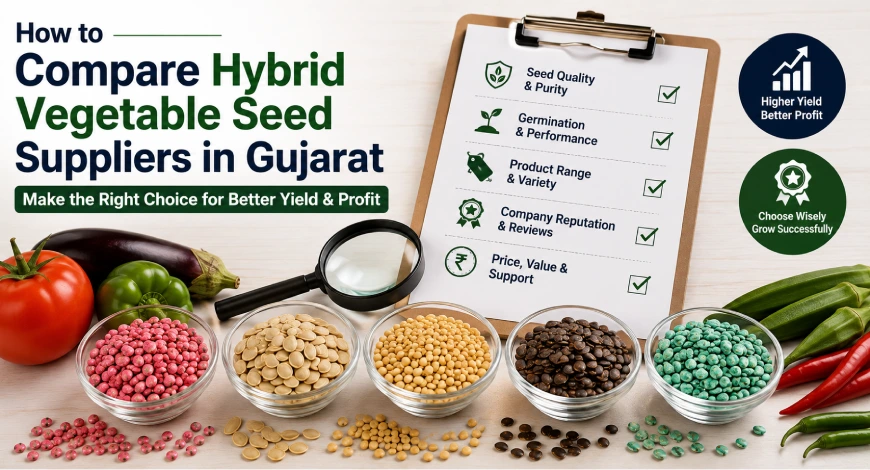
Create a simple scorecard to compare suppliers consistently over time. Evaluate seed quality, crop suitability, field performance, product transparency, supply reliability, technical support, pricing and repeat-order performance.
This helps farmers, distributors, FPOs, cooperatives and institutional buyers choose reliable suppliers for long-term partnerships.
Why Gujarat Matters for Vegetable Seed Buyers
Gujarat’s diverse agricultural regions create demand for vegetable hybrids suited to different production conditions and market channels. This makes supplier selection more important than simply buying from the nearest distributor.
A strong comparison should combine seed quality, regional suitability, technical information, supply reliability and business transparency.
ICAR also continues to emphasize improved hybrids, quality seed production and technologies suited to different agro-climatic situations, showing why seed selection needs to be connected with local growing conditions rather than treated as a one-size-fits-all decision.
Final Thoughts
The best Hybrid Vegetable Seeds Supplier Gujarat is not simply the one offering the lowest price or the highest yield claims. Buyers should consider seed quality, crop suitability, field performance, transparency, supply reliability, technical support and consistency.
For farmers and professional buyers in Gujarat, testing hybrid seeds on a practical scale before placing larger orders can provide better insights than price comparisons alone. TRS Seeds India Pvt. Ltd. focuses on quality hybrid vegetable seeds and reliable support, helping farmers, dealers and institutional buyers make informed choices for upcoming seasons.
FAQ
1. How should I compare Hybrid Vegetable Seed Suppliers Gujarat?
Compare suppliers based on seed quality testing, crop suitability, field performance, product information, supply reliability, technical support and traceability. Price should be considered alongside these factors. For commercial cultivation, a supplier’s ability to provide consistent seed quality and timely supply can be more important than a low initial quotation.
2. What should I ask a Hybrid Vegetable Seeds Supplier in India before buying?
Ask about germination standards, seed-lot information, crop suitability, recommended growing conditions, quality testing, packing, availability and complaint handling. If purchasing commercially, also discuss bulk supply capacity and repeat availability. Clear answers help distinguish a structured seed supplier from one relying mainly on promotional claims.
3. Are Hybrid Seeds in India suitable for every region?
No. Hybrid performance depends on factors such as climate, soil, irrigation, crop management, pest pressure and season. A hybrid performing well in one region may behave differently elsewhere. Farmers should consider local field performance and recommendations instead of assuming that one hybrid will deliver identical results across India.
4. How can farmers identify reliable Vegetable Seeds Suppliers?
Look for suppliers that provide clear product details, quality information, lot identification, proper packaging and consistent availability. Farmers should also consider field performance and after-sales communication. A small trial before a large purchase can help verify whether the product suits their soil, climate, cultivation method and target market.
5. Is the cheapest seed supplier always the best option?
Not necessarily. Seed price is only one part of the total cultivation cost. Poor establishment, uneven crop growth, unsuitable fruit characteristics, or unreliable supply can increase losses. A better comparison considers quality, expected marketable output, consistency, technical information and supplier reliability along with the purchase price.
6. What makes a Best Hybrid Seeds Company in India reliable?
A reliable company should combine quality-focused seed production, suitable hybrid development, testing, proper processing and packaging, transparent product information and dependable distribution. Farmers should also look for evidence of field evaluation and consistent product performance rather than selecting a company solely because of brand visibility or advertising.