
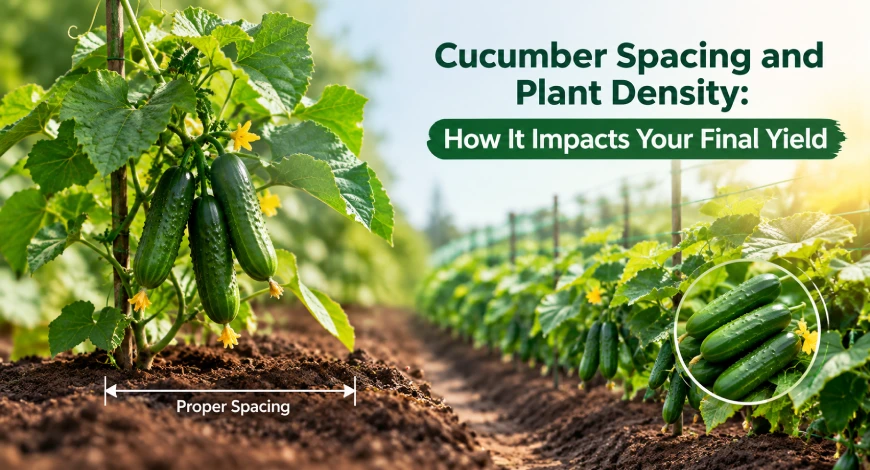
Cucumber Spacing and Plant Density can directly influence how efficiently a crop uses sunlight, water, nutrients and available field space. For farmers growing commercial cucumber crops, choosing the right layout is not simply about fitting more plants into an acre.
When selecting Hybrid Cucumber Seeds, spacing should be considered alongside variety characteristics, training method, soil, irrigation and local growing conditions. The right plant population can help create a more manageable crop canopy and support consistent fruit development.
Why Cucumber Plant Density Matters
Cucumber plants need sufficient access to sunlight, moisture and nutrients. When plants are crowded, their leaves and vines compete for available resources.
The University of Minnesota Extension notes that closely planted cucurbits can compete for light and nutrients, while adequate spacing supports better growth. Its commercial guidance lists cucumber spacing of about 15–18 inches between plants and 4-6 feet between rows, although actual recommendations vary by production system and variety.
This means farmers should treat spacing recommendations as a starting point rather than a universal formula.
How Spacing Can Affect Final Yield
1. Better Light Distribution
Leaves need adequate light for photosynthesis. If the canopy becomes excessively crowded, some leaves may receive less direct sunlight.
A well-planned layout gives plants enough growing room while allowing the crop canopy to develop without excessive overlap.
This becomes especially important with vigorous high-yield hybrid cucumber seeds, where plant growth characteristics can differ between varieties.
2. Improved Air Movement
Dense cucumber canopies can hold moisture around leaves and stems for longer periods.
Good spacing creates more room for air movement. Extension guidance for cucurbit diseases also recommends adequate spacing and trellising to improve air circulation and help keep foliage drier.
Better airflow does not eliminate disease risk but it can form part of a broader crop-management strategy.
3. Easier Crop Monitoring
A practical benefit of suitable plant density is easier field observation.
Farmers can more easily inspect plants for:
- Pest activity
- Leaf symptoms
- Flower development
- Fruit formation
- Irrigation problems
- Weed pressure
This allows problems to be identified earlier instead of discovering them after the canopy has become difficult to access.
Row Spacing vs Plant-to-Plant Spacing
Farmers should distinguish between row spacing and plant-to-plant spacing.
Row spacing determines the distance between planting rows. It affects field access, equipment movement, canopy spread and airflow.
Plant-to-plant spacing determines how much growing room each cucumber plant receives within the row.
Changing either measurement changes the overall plant population. Therefore, increasing plant numbers should not automatically be treated as a way to increase yield.
Does Higher Plant Density Always Mean Higher Yield?
Not necessarily.
Adding more plants can increase the number of plants occupying a given area, but excessive density can also increase competition for light, nutrients and water.
The University of Minnesota Extension specifically notes that excessive crowding can reduce photosynthesis and growth in cucurbits.
The objective should therefore be productive plant density, not simply maximum plant density.
How Hybrid Variety Choice Changes the Equation
Different cucumber hybrids can have different growth habits, vine strength, fruit characteristics and responses to local conditions.
That is why farmers should consider the variety’s recommended production method before finalising field layout.
When purchasing from Vegetable Seeds Suppliers, ask for relevant crop information rather than relying only on a general cucumber spacing chart.
A dependable india seed company should be able to provide variety-specific information where available, helping farmers align seed selection with their intended production system.
Open-Field vs Trellised Cucumber Production
Spacing requirements can also change according to how the crop is trained.
In trellised systems, vines are trained vertically rather than allowed to spread across the soil. Extension guidance notes that trellising can improve air circulation and can also produce cleaner, straighter fruit in suitable vine crops.
Farmers should therefore avoid copying spacing from an open-field system directly into a trellised production model.
A Practical Way to Decide Plant Density
Before planting a large commercial area, consider these factors:
- Hybrid growth habit
- Recommended spacing from the seed supplier
- Open-field or trellis system
- Soil fertility
- Irrigation method
- Expected vine development
- Local climate
- Machinery and field access
- Disease history of the field
A small trial section can also be useful when introducing a new hybrid. Compare plant growth, canopy development, flowering, fruit set and harvest performance before expanding the same layout across a larger area.
Choosing Seeds and Spacing Together
Good crop planning starts before sowing. Farmers looking for Hybrid Seeds in Agriculture should evaluate the seed’s characteristics alongside the production environment.
For growers sourcing from Hybrid Vegetable Seeds Suppliers in Gujarat or other regional suppliers, local climate, soil and cultivation practices should be considered when deciding the final planting arrangement.
Seed quality, spacing, irrigation, nutrition, crop protection and timely harvesting all work together. Spacing alone cannot guarantee a particular yield.
Final Takeaway
Cucumber Spacing and Plant Density are important parts of yield-oriented crop management. Too little space can increase competition and restrict airflow, while excessive spacing may underuse available field area.
The most practical approach is to combine variety-specific recommendations with local growing conditions, irrigation, training method and field experience. Choosing suitable hybrid seed and then validating the spacing through a small trial can help farmers make better planting decisions for commercial production.
FAQ
1. What is the ideal cucumber spacing for commercial farming?
Spacing depends on the hybrid, training system, soil, climate and production method. Commercial guidance from the University of Minnesota Extension lists approximately 15–18 inches between cucumber plants and 4-6 feet between rows, but farmers should follow variety-specific recommendations and adapt them to their local growing conditions.
2. Does higher cucumber plant density increase yield?
Higher plant density does not automatically produce higher yield. Excessive crowding can increase competition for sunlight, nutrients and water and may restrict airflow. Farmers should target a productive plant population based on the hybrid’s growth habit, cultivation system, soil conditions, irrigation and local recommendations rather than simply maximising plant numbers.
3. How does spacing affect high-yield hybrid cucumber seeds?
Spacing influences how effectively a vigorous hybrid uses available light, nutrients, water and field space. High-yield hybrid cucumber seeds should therefore be planted according to their growth habit and recommended cultivation method. A suitable spacing plan can also make crop monitoring, harvesting and canopy management easier.
4. Should cucumber spacing change when using a trellis?
Yes, the spacing plan may change when cucumbers are trained vertically. Trellising changes how vines occupy field space and can improve airflow. Farmers should follow the hybrid’s cultivation guidance and design row spacing around the support system, irrigation layout, field access and expected vine growth.
5. What should farmers ask vegetable seeds suppliers about cucumber spacing?
Farmers should ask Vegetable Seeds Suppliers about the hybrid’s growth habit, recommended plant population, row and plant spacing, trellising suitability, maturity period and relevant disease characteristics. These details can help farmers choose a planting layout that fits their field conditions instead of using a generic cucumber spacing recommendation.
6. Can Hybrid Vegetable Seeds Suppliers in Gujarat provide spacing guidance?
Suppliers may provide cultivation recommendations for specific hybrids, but the final spacing decision should also consider local soil, climate, irrigation, training method and field conditions. Farmers can discuss the variety’s characteristics with Hybrid Vegetable Seeds Suppliers in Gujarat and validate the recommended layout through a suitable field trial.