
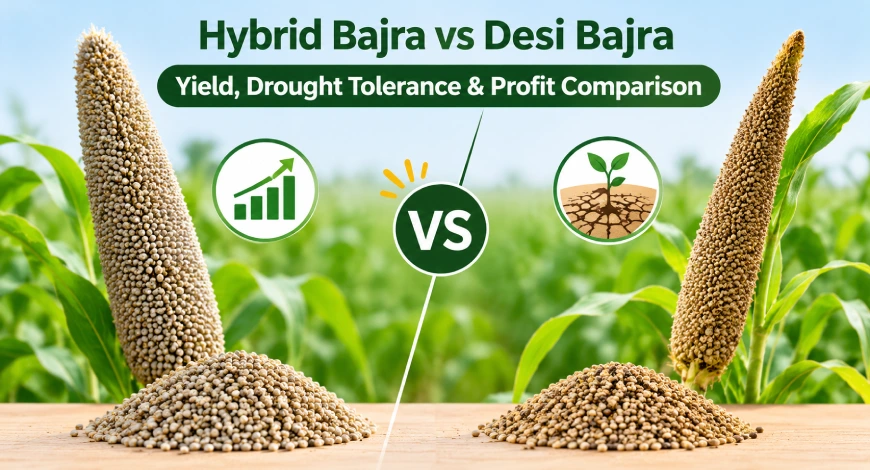
Choosing between Hybrid Bajra vs Desi Bajra is an important decision for farmers planning pearl millet cultivation. Both options have different characteristics in terms of seed cost, crop performance, drought response and farm economics. The right choice depends on rainfall, soil conditions, available resources and the market for harvested grain.
Farmers exploring Hybrid Bajra Seeds should compare the hybrid’s recommended growing conditions with the performance of locally adapted desi varieties before purchasing.
1. Understanding Hybrid Bajra and Desi Bajra
Hybrid bajra is developed by crossing selected parent lines to produce seed with specific characteristics. Depending on the hybrid, these may include yield potential, plant growth, maturity period and grain features.
Desi bajra generally refers to traditional or locally maintained varieties and landraces. Farmers may value them for their familiarity, local adaptation, grain characteristics or suitability for traditional farming practices.
One important difference is seed saving. Seed collected from hybrid crops may not reproduce the same characteristics uniformly in the next generation. Traditional varieties may allow farmers to save seed, provided they maintain good selection and seed-storage practices.
2. Yield Potential: Which Option Produces More?
Hybrid bajra varieties are often selected for their yield potential under recommended growing conditions. However, actual production depends on rainfall, soil fertility, sowing time, plant population and crop management.
Desi varieties may offer more familiar performance in particular local conditions, but their yield potential can vary widely.
Before comparing yields, consider:
- Grain yield under similar field conditions
- Crop duration and maturity
- Tillering and earhead development
- Response to fertiliser and irrigation
- Previous performance in the same village or region
Do not judge a variety using yield figures from a different location or season. Local field observations provide a more useful basis for comparison.
3. Drought Tolerance: Look Beyond the Seed Category
Bajra is widely grown in dry and semi-arid regions because pearl millet can perform under challenging moisture conditions. However, drought tolerance is not identical across all hybrids and traditional varieties.
A locally adapted desi variety may have useful characteristics developed through long-term cultivation in a particular area. Some hybrids may also offer drought-related advantages, depending on their breeding characteristics.
Farmers should check:
- Recommended rainfall and growing conditions
- Performance under moisture stress
- Crop duration and ability to escape late-season drought
- Root and plant characteristics, where information is available
- Local trial results or farmer observations
The ICAR–Indian Institute of Millets Research provides research and technical resources on millet crops, including pearl millet. Farmers can use such resources alongside local agricultural advice when comparing varieties.
4. Seed Cost and Farm Profit Comparison
A lower seed cost does not always mean higher profit. Hybrid bajra generally requires purchasing fresh seeds, while desi bajra seeds may be saved for future sowing with proper selection. However, saved hybrid seeds may not retain the same characteristics in the next generation.
Farmers should compare seed costs, yield potential, fertiliser, labour, irrigation, harvesting and market demand before choosing a variety.
Calculate Profit Before Selecting Seeds
Use this simple formula:
Net Return = Total Crop Income − Total Cultivation Cost
Consider local yield estimates and expected grain prices to decide whether the additional investment in hybrid bajra seeds is likely to provide better returns.
5. Hybrid Bajra vs Desi Bajra
Farmers considering Hybrid Field Crop Seeds in Gujarat should assess their district’s rainfall pattern, soil type, sowing window and irrigation facilities.
For example, a rainfed farm with uncertain rainfall may require a different variety-selection approach from an irrigated farm with better moisture control.
Ask seed suppliers about:
- Recommended sowing season and region
- Crop duration and maturity
- Grain characteristics
- Performance information under local conditions
- Recommended seed rate and spacing
These details are useful when comparing hybrid bajra seed suppliers in India and selecting products for small or large farms.
6. How to Choose a Reliable Bajra Seed Supplier
When comparing Hybrid Seeds Suppliers, check the product label, hybrid or variety name, seed-lot details, packing information and sowing recommendations.
A reliable Seeds Producer Company in India should provide clear product information rather than promising guaranteed yields. Farmers should also retain the purchase bill and seed packet for reference.
TRS Seeds India Pvt. Ltd. offers hybrid field crop seed options for agricultural buyers. Review its available bajra varieties and confirm their suitability for your region before ordering.
Final Thoughts
The choice between hybrid and desi bajra should depend on farm conditions, seed costs, grain requirements and expected returns. Hybrid options may suit farmers seeking specific breeding characteristics, while locally adapted desi varieties may fit farms with established seed-saving practices.
Compare actual field performance rather than relying on general claims. The right Bajra Seeds choice is the one that matches your growing conditions and farm budget.
FAQ
1. Which is better, hybrid bajra or desi bajra?
The better option depends on rainfall, soil, seed budget and grain or fodder requirements. Hybrids may offer higher yield potential under suitable management, while some desi types are valued for local adaptation and traditional use. Compare locally relevant performance before deciding.
2. Do high-yield hybrid bajra seeds perform well in drought conditions?
Some hybrids are developed for moisture-stressed environments, but drought response differs by hybrid. Farmers should check the recommended growing region, maturity period and available stress-tolerance information. Timely sowing, suitable plant population and soil moisture management remain important.
3. Can farmers save seeds from hybrid bajra crops?
Seed saved from an F1 hybrid generally does not retain the same uniformity and combination of traits in the next generation. Plants may vary in maturity, height and yield. Farmers seeking consistent hybrid performance should purchase fresh, properly labelled seed for each season.
4. How should farmers compare hybrid bajra seed suppliers in India?
Check the hybrid’s recommended region, crop duration, grain and fodder traits, seed-lot details and packing information. Ask for clear cultivation guidance and retain the purchase bill. Avoid selecting a supplier based only on low seed prices or unsupported yield promises.
5. Is desi bajra more drought-tolerant than hybrid bajra?
Not always. Drought response varies among individual hybrids and traditional landraces. Some improved hybrids have been developed for dry regions, while certain local types may be adapted to harsh conditions. Compare specific varieties using local agricultural recommendations and field results.