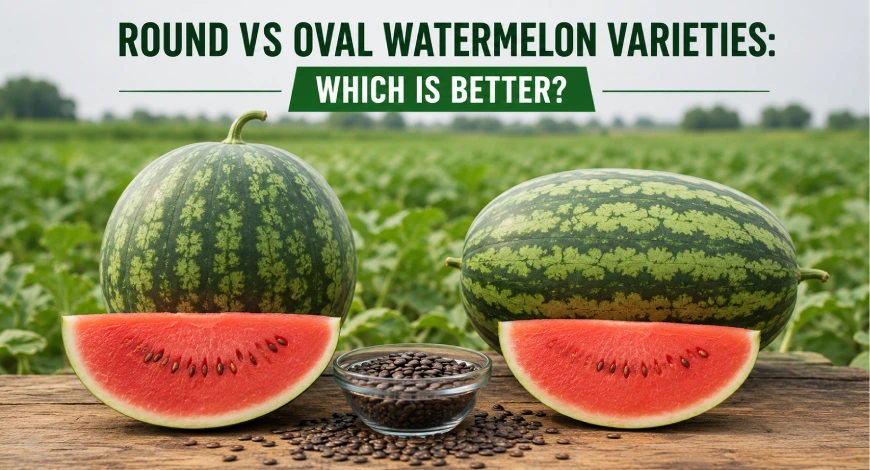
Choosing the right watermelon variety can significantly impact yield, market acceptance, transportation efficiency and overall farm profitability. When comparing Round vs Oval Watermelon Varieties, many growers wonder which shape delivers better returns and suits their target market.
Today, commercial farmers increasingly rely on quality genetics from a trusted Hybrid Watermelon Seeds Supplier in India to achieve consistent fruit size, better sweetness and improved field performance.
This guide explores the key differences between round and oval watermelon varieties to help farmers make informed cultivation decisions.
Understanding Round Watermelon Varieties
Round watermelons are among the most recognizable watermelon types in Indian markets.
Key Characteristics
- Nearly spherical fruit shape
- Attractive retail appearance
- Uniform fruit development
- Popular in fresh fruit markets
Many consumers associate round watermelons with traditional watermelon cultivation.
Advantages of Round Varieties
Strong Consumer Recognition
Round fruits are widely accepted in retail and wholesale markets.
Attractive Display Value
Their symmetrical appearance often enhances visual appeal in supermarkets and fruit stalls.
Uniform Fruit Development
Many modern F1 hybrid watermelon seeds produce highly consistent round fruits.
Limitations of Round Varieties
Round fruits may require more storage and transportation space because of their shape.
Packing efficiency can sometimes be lower compared to elongated varieties.
Understanding Oval Watermelon Varieties
Oval watermelons have become increasingly popular among commercial growers and exporters.
Key Characteristics
- Elongated fruit shape
- Efficient packing and transportation
- High market acceptance in many regions
Several modern hybrid watermelon seeds are specifically bred in oval shapes for commercial distribution.
Advantages of Oval Varieties
Better Transportation Efficiency
Oval fruits typically fit more efficiently in transport crates and shipping containers.
Reduced Handling Losses
Improved packing arrangements can help reduce fruit movement and damage during transportation.
Popular in Commercial Supply Chains
Large distributors often prefer oval fruits because they simplify logistics.
Limitations of Oval Varieties
Consumer preferences vary by region. Some local markets continue to favor traditional round fruits.
Yield Comparison of Round vs Oval Watermelon Varieties
Is Shape Linked to Yield?
Fruit shape alone does not determine yield.
Yield depends on:
- Variety genetics
- Crop management
- Soil fertility
- Irrigation practices
- Disease control
Both round and oval varieties can deliver excellent productivity when grown under proper conditions.
Importance of Hybrid Genetics
Many of the best hybrid watermelon seeds are developed to provide:
- Strong plant vigor
- Uniform fruit setting
- Higher marketable yield
- Better disease resistance
The genetic quality of the seed is often more important than fruit shape.
Market Demand Analysis
Local Fresh Markets
In many traditional retail markets:
- Round watermelons remain highly recognizable
- Consumers often associate them with freshness
- Visual appeal influences purchasing decisions
Wholesale and Export Markets
Commercial buyers frequently prioritize:
- Consistent sizing
- Efficient packaging
- Reduced transport costs
For these reasons, oval varieties are increasingly popular in organized supply chains.
According to guidance from the Indian Council of Agricultural Research (ICAR) , integrated crop management practices improve fruit quality and help maximize yield potential in watermelon cultivation.
Which Variety Is Better for Farmers?
Choose Round Watermelon Varieties If:
- You primarily sell in local markets
- Consumer appearance preferences are important
- Retail display value is a priority
Choose Oval Watermelon Varieties If:
- You supply wholesalers
- You target export markets
- Transportation efficiency is critical
Many successful growers cultivate both types to diversify their market opportunities.
Future Trends in Watermelon Farming
As supply chains become more organized, growers are increasingly selecting varieties based on market requirements rather than appearance alone.
Modern breeding programs continue to develop:
- Better-tasting fruits
- Higher-yielding hybrids
- Improved disease resistance
- Enhanced transportability
These innovations allow farmers to choose varieties that align closely with buyer expectations.
Final Thoughts
Choosing between round and oval watermelon varieties depends on your target market, distribution strategy and production goals. Round watermelons remain popular in traditional retail markets, while oval varieties often support efficient packaging, transportation and large-scale commercial sales.
For the best results, farmers should combine strong crop management practices with high-quality seed genetics. TRS Seeds India Pvt. Ltd. offers premium hybrid watermelon seeds developed for high yield, fruit quality and market performance, helping growers maximize profitability and meet evolving consumer demands.
FAQ
1. Which is better: round or oval watermelon varieties?
Both have advantages. Round watermelons are popular in local markets for their traditional appearance, while oval varieties often provide better packing efficiency and transportation benefits for commercial supply chains.
2. Do oval watermelons produce higher yields than round varieties?
Not necessarily. Yield depends more on genetics, crop management, irrigation and soil conditions than on fruit shape. Both types can produce excellent yields under proper cultivation practices.
3. Are hybrid watermelon seeds better for commercial farming?
Yes. Many hybrid watermelon seeds offer improved disease resistance, uniform fruit development, higher productivity and stronger market acceptance compared to traditional varieties.
4. Which watermelon shape is preferred by exporters?
Many exporters prefer oval watermelon varieties because they are easier to pack, transport and stack efficiently during long-distance shipping operations.
5. How do I choose the best hybrid watermelon seeds?
Select varieties based on local climate, target market, disease resistance, fruit quality and yield potential. Working with an experienced supplier can help identify suitable options.